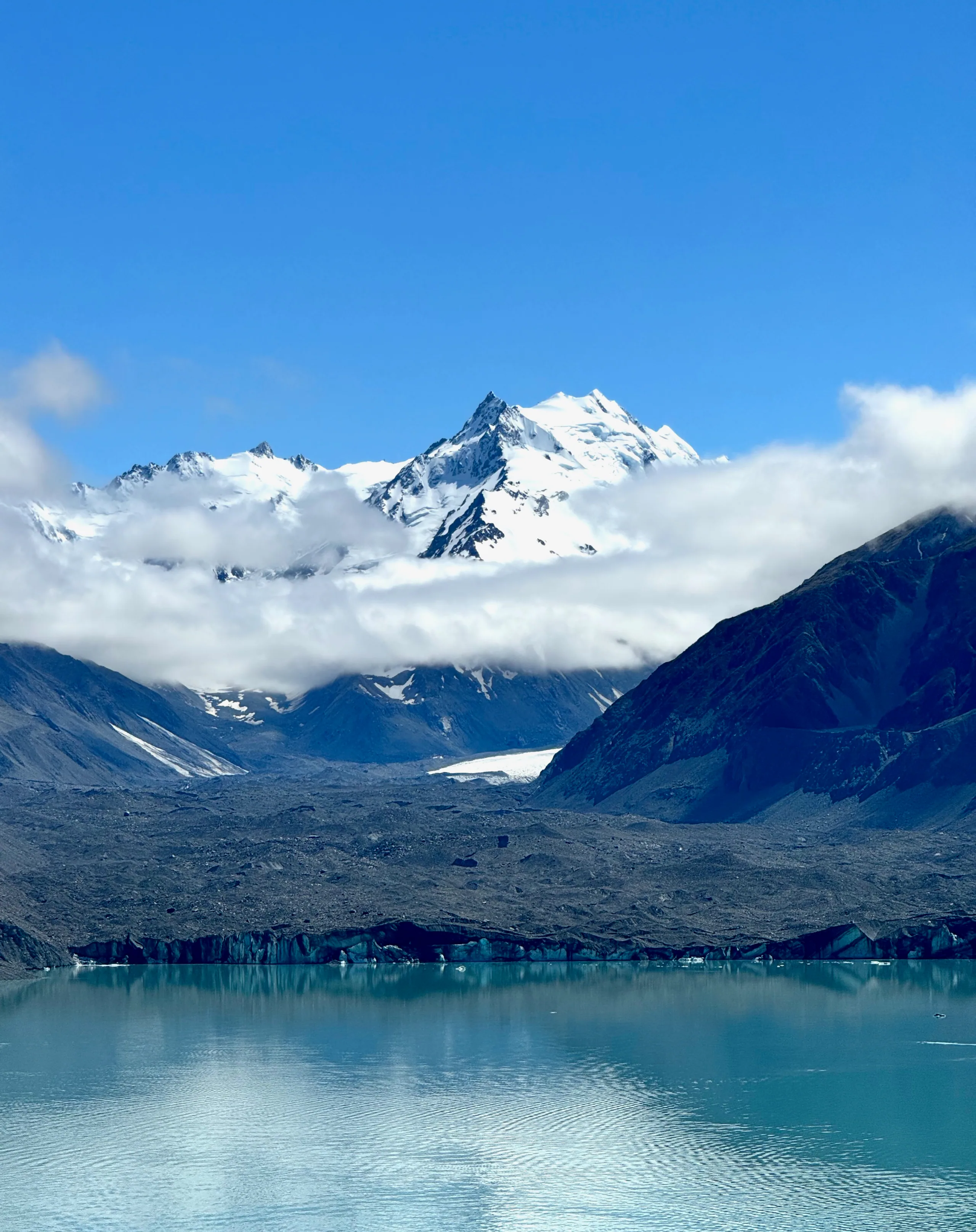
Views from Mount Cook Village
It’s silly to call Mount Cook Village a destination when it’s just two hotels and some employee housing (no one else is allowed to live here). But nearly every single north-facing view stunned me. The short, squat town provided first-row seats to the incredible scenery of the northern Tasman and Hooker Valleys and, of course, the mountain Aoraki himself.
The weather changes quickly and Aoraki, the highest mountain in New Zealand, is bashful. Where one morning it can be sunny and visible, in minutes the sky can dim and the mountain can disappear. It was exciting to see all the ways we could observe the mountain range. The exact silhouette of Aoraki is etched in my brain now.
Tasman Glacier Lake
We came back multiple times to the Tasman Glacier Lake (in addition to flying over it, of course) since it offered so many short hikes. All of them end at a different perspective of the lake: above, to the side, and all the way down to the shoreline.
As every guide will end up telling you (always nod enthusiastically and act surprised), glacial lakes tend to be so turquoise because the movement of the glacier crushes the rock into fine particles (NASA). The “glacial flour” that results is suspended in the water. The Tasman Lake is directly below the Tasman Glacier, but the effect is also quite pronounced on the bigger Lake Pukaki that it flows into.
Our late-spring trip meant that most of the snow near the Tasman Lake itself had melted, replaced by relatively dry rock faces and some greenery in the valley. The lake itself, however, will only be getting larger. The Glacier now sits partially in the water, melting it quickly and sheering off ice from the glacier face.
Rain at Kea Point
We made a quick late-afternoon trip to Kea Point, but the weather wasn’t cooperative. It was a damp climb up that quickly turned into light rain on the way down. Our silver lining was on the way up, where clouds literally framed Aoraki/Mt Cook.
Our guides told us that the very first climb of the mountain, summiting in 1894, was done via a relatively difficult path—one that was not repeated for another 60 years. (Te Ara) Nowadays, most people who attempt the climb do so via an easier path. Even so, the mountain is New Zealand’s deadliest.
Encounter under the night sky
The national park sits at the heart of the largest “dark sky reserve” in the Southern Hemisphere, and being on the other half of the planet presents some interesting perspectives (No North Star! Everything is upside down!).
Thus, at midnight we drove down dark roads to search for a good spot for night photography. We were on a timer: wait too long, and the moon rises, washing out any stars from the sky. Our first challenge was finding a spot.
My first idea was the Mt Cook Airport, since I had been there earlier in the day and the surroundings were wide open. I was very pleased when we pulled in: there was magnificent twinkle in the sky from every direction. Not one minute in, however, I was informed by a voice in the dark that I was trespassing on an “official” night sky gazing session. Politely but forcefully, I was asked to move along—but not before the guide gave me a suggestion: head over to Tasman Lake trailhead.
I saw nothing except the road ahead lit up in my high beams. The 15-minute drive flew by. When we pulled into parking, I sprinted up the trail in the dark with my phone flashlight lighting the way.
I managed to capture just a few photos before I heard the sound of a scuffle as someone, something, suddenly stopped scampering across the gravel path. From my tripod I carefully removed my phone—my camera and only light source—and turned on the flashlight. Dead in the middle of the path was a large possum—a “common brushtail possum,” I later learned. An invasive species to New Zealand, and an invader of my moment.
It was not very large, not more than a foot in height. It stood directly upright, its bright large eyes staring right at me, its body unmoving. While I wasn’t scared of it, I was unsure what it would do next. There it watched me, slightly amused, as I yelled at it.
The possum decided. Rather than run away, it ran straight towards me and, several feet away, launched itself at me. Its front paws struck me in the belly with a surprising amount of force. There was an audible gasp from Kathryn, who was standing several meters away in disbelief. Like some display of street parkour, the possum had given me some kind of mighty kick before scampering away. I saw its hind legs as it darted into the bushes. Sweeping my flashlight around, it was nowhere to be seen anymore.