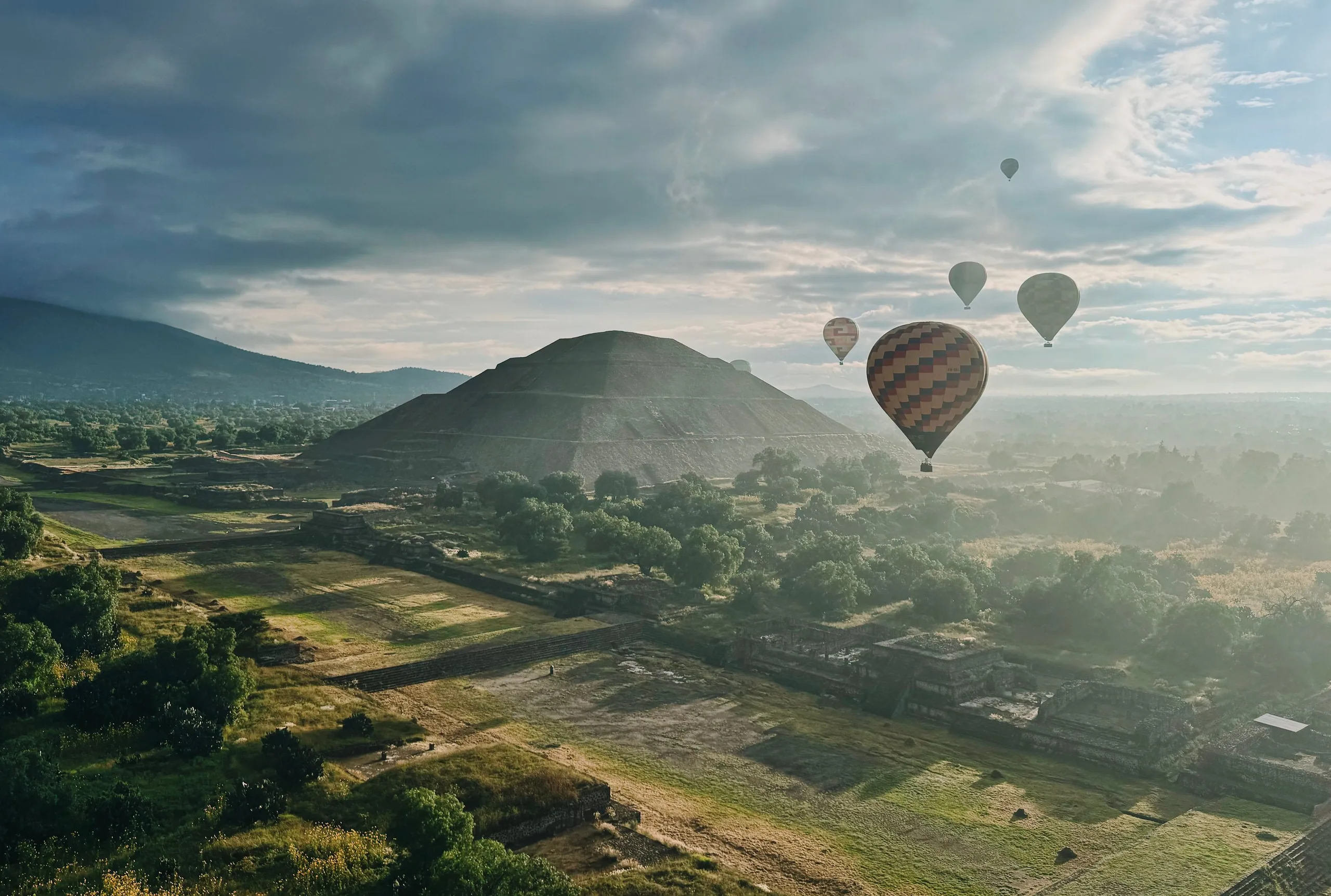
No trip to Mexico City is complete without its signature adventure: a hot air balloon ride over the ancient city of Teotihuacan, once the metropolis capital of Mesoamerica and home to hundreds of thousands.
If you think you’re too good to wake up at 4am for a hot air balloon ride, you’re wrong. This experience is a must: an iconic perspective that’s both stunning and entirely unique, and a breathtaking (and easier) way to experience an incredible archeological site.
In the days leading up to our October visit, the rainy season (and nearby hurricane) meant that the weather was unsettled and concerningly wet. Since an unobstructed sunrise is ideal, even a cloudy morning can dampen the experience. At worst, our hot air balloon ride could be canceled last minute.
Luckily, our first hot air balloon ride couldn’t have been more magical. As dawn broke and the crew prepared the balloons, the clouds began to clear. The ascent was so gentle that we barely noticed it. In a matter of seconds, we found ourselves high above the landscape, mesmerized by the view.
All the balloon tours seemed well-organized and professional. The magic isn’t just in seeing the pyramids from above; it’s also in watching the sky fill with other balloons. (Get in an ugly one! You won’t see it!) On any given day, over a hundred balloons take flight, creating an unforgettable scene as they drift over the pyramids.
Here are some interesting fun facts on the Teotihuacan hot air balloon ride, which I was able to squeeze out of our pilot after we landed.
First, the most important—the only thing the pilots can do is climb or descend the balloon, so they are looking for consistent currents that will bring them in a southwest direction (almost all balloons launch to the northeast of the pyramids). Since each elevation has slightly differing currents, there’s usually enough control to “steer” the balloon a bit by going up or down.
This is both a skill and a game of luck. Frankly, some pilots were worse at this than others; some other balloon rides seemed substantially shorter than ours. Once you fly past the pyramids, that’s it. The currents don’t vary enough that you can go backwards.
Second, they can get pretty close—although Mexican aviation regulations don’t allow directly overflying the pyramids. They can also get super low—at points, we were no more than 10 meters off the ground mid-flight.
Third, after overflying the archeological sites, pilots play a fun game of picking a place to land. The logistics of this were very fascinating to me. Hot air balloon companies and the owners of empty fields actually have landing agreements, allowing balloons to land for ~$10 USD.
So pilots are intersecting which fields they have permission to land in, with which fields the balloon can actually get to. When they decide on a field, they radio ahead to a ground crew who has been driving around town chasing the balloon in a truck with a flatbed trailer.
The ground crew hauls it to the landing site, and the balloon hovers in the field until they get there. But it wasn’t until our balloon got quite low that I realized the fields are actually quite thistly and unkept, with shrubs and plants up to shoulder height. These aren’t fields that a truck can easily pull into—so the truck drives as far in as they can and then the ground crew hops out, trudges through the field, and then pushes the balloon out of the deep end of the field by hand. This takes 4 guys a decent amount of work, even though the balloon is buoyant and floating a few feet above the ground.
When the balloon finally gets pushed over the flatbed trailer, the basket then fully lowers onto the flatbed. With everything secure, a single cord pull releases all the hot air (!) and the balloon collapses within 10 seconds into a pile on the ground.